Migraine relief cap: the complete guide (2026)
⚡ Key takeaways
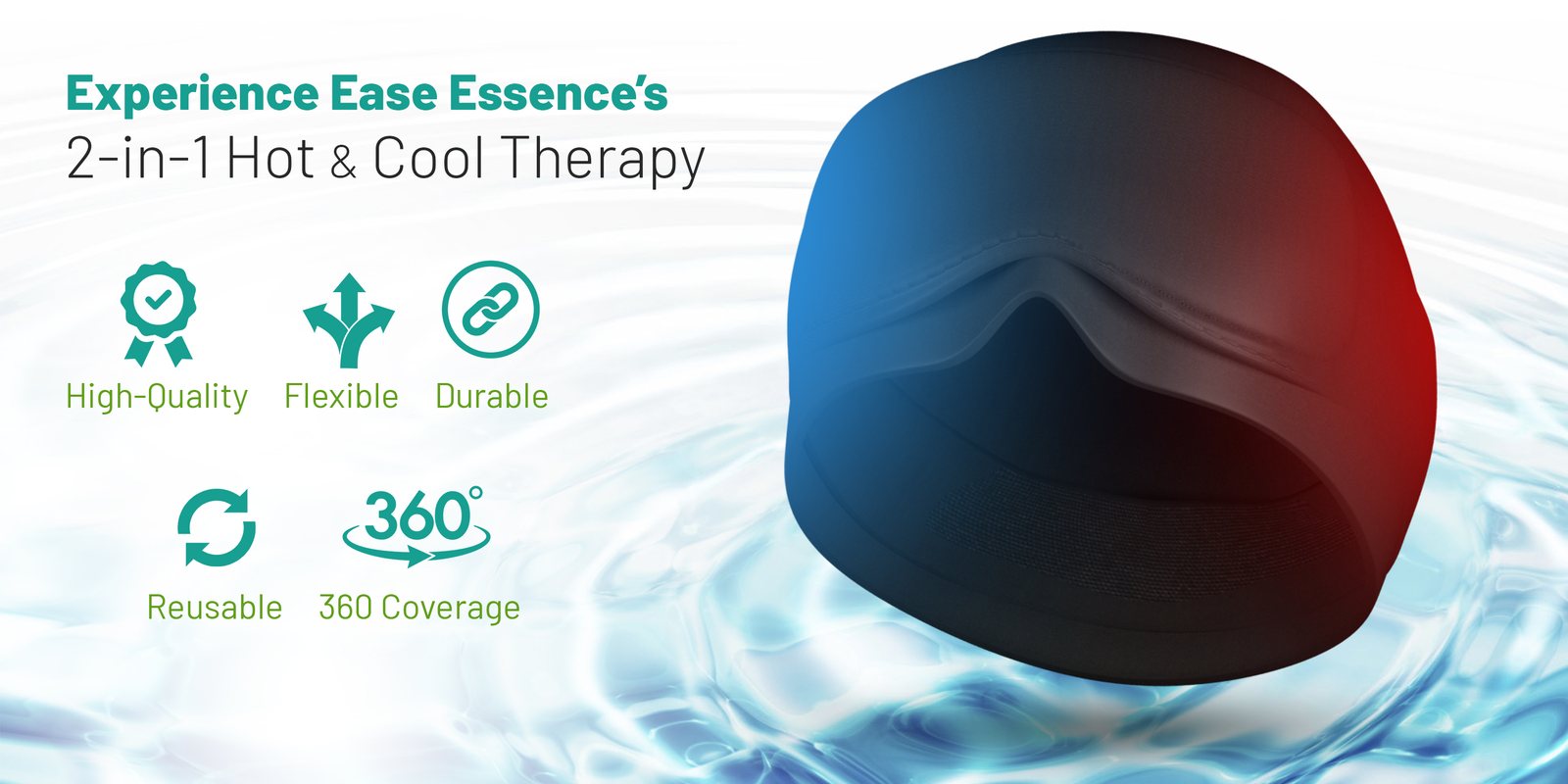
- A migraine relief cap is a gel-filled, wrap-around headband that delivers hot or cold therapy hands-free to the forehead, temples and back of the head — right where migraine pain lives.
- Cold works by vasoconstriction and nerve cooling; heat works by relaxing tight muscles and improving circulation. Both are well-established, drug-free comfort strategies.
- 360° coverage is what separates a good cap from a flat ice pack — migraine pain is not a single spot, and a wrap treats the whole zone at once.
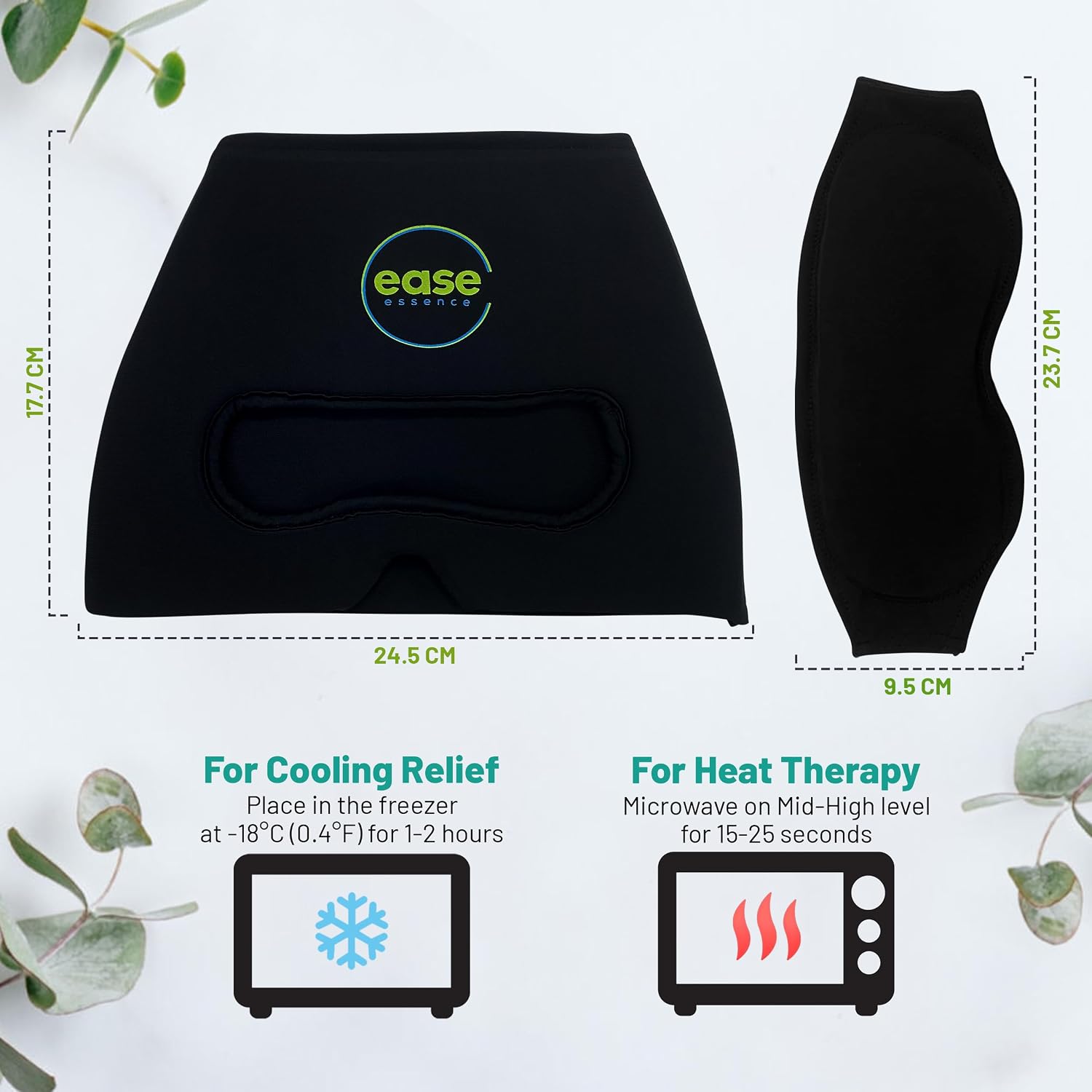
- Freeze at −18°C for 1–2 hours, or microwave at medium-high for 15–25 seconds for warmth. Use for sessions of roughly 15–20 minutes with a fabric layer against the skin.
- The Ease Essence cap is rated 4.3★ across 220 Amazon ratings and includes a detachable gel eye mask — for simultaneous light-blocking and eye-area cooling or warming.
If you suffer from migraines, you've probably tried a lot of things. And somewhere in that search you likely discovered what millions of people have quietly relied on for decades: pressing something cold — or occasionally warm — against your head actually helps. A migraine relief cap takes that instinct and turns it into a purpose-built tool. This guide covers everything you need to know: what it is, why it works, how to use it, what it helps beyond migraines, how it compares to alternatives, and what to look for before you buy.
What is a migraine relief cap?
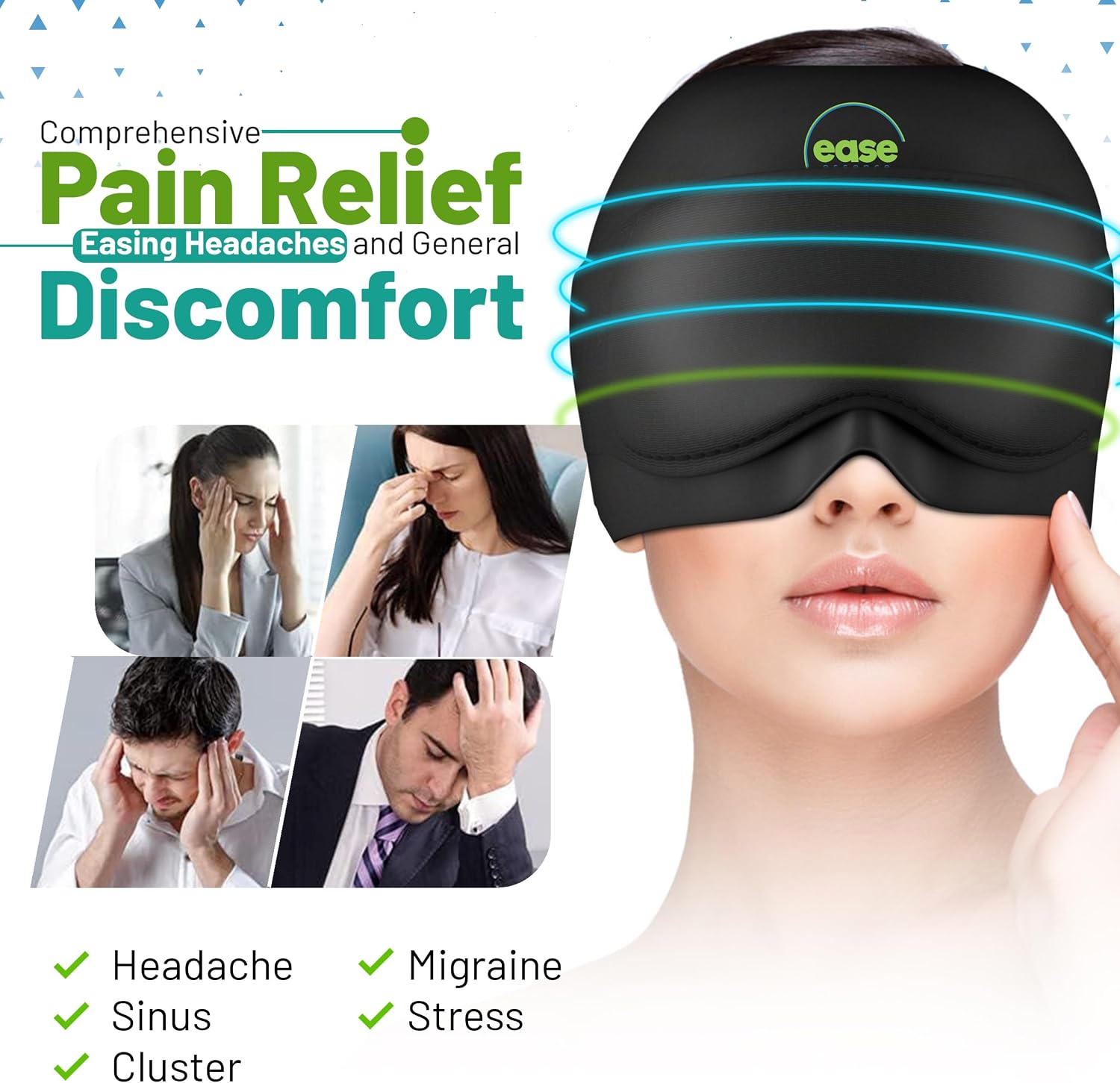
A migraine relief cap — sometimes called a migraine cap, headache hat, or ice head wrap — is a wearable, gel-filled wrap designed to encircle the skull. Unlike a bag of ice or a flat gel pack you press against one temple, a purpose-built cap uses a flexible gel panel or multiple gel sections sewn into an elasticated fabric shell so it conforms to the shape of your head and stays in place.
The defining features that make a cap genuinely useful are:
- Wrap-around coverage — the forehead, temples, crown and back of the head are all in contact with the therapy surface simultaneously.
- Hands-free wear — it stays on when you lie down, which is almost always where you end up during a migraine.
- Dual hot/cold capability — quality caps can be chilled in the freezer for cold therapy or gently warmed in the microwave for heat therapy, depending on what your body responds to.
- Optional eye mask attachment — some models include a detachable gel panel that covers the eyes, adding a light-blocking layer and extending therapy to the eye socket area.
These aren't complicated devices. They don't require electricity, apps or a prescription. That simplicity is most of the point.
How a migraine relief cap works
There are two distinct modes — cold and heat — and each works through a different physiological pathway. Most migraine sufferers find cold more helpful for the acute attack; heat tends to be better for tension-type or muscle-related headaches. Many people use both at different times.
Cold therapy
Cold is the more studied of the two for migraine specifically. Our deep-dive article on cold therapy for migraines covers the science in detail, but the short version is this: migraines involve the dilation of blood vessels around the brain and the release of inflammatory molecules that make those vessels painfully sensitive. Cold counters this through three mechanisms.
First, vasoconstriction — cold causes blood vessels to narrow, reducing the dilation and the throbbing it produces. Second, cold slows nerve conduction, meaning the speed at which pain signals travel along nearby sensory nerves is reduced, turning down the intensity of the hurt. Third, there is a simple numbing and counter-stimulation effect — cold provides a competing sensation that can partially mask pain through the body's own sensory-gating mechanisms.
A 2013 clinical study in the Hawai'i Journal of Medicine & Public Health found that applying cold at migraine onset produced a significant reduction in reported pain. The timing matters: cold is most effective applied at the very beginning of an attack, not an hour into it.
Heat therapy
Heat works through opposite but complementary mechanisms. Rather than constricting vessels, warmth dilates blood vessels and relaxes muscle tissue — which is why it tends to be more helpful for tension headaches and neck-muscle-related head pain than for the acute vascular phase of a migraine. Heat also has a soothing, parasympathetic effect that can reduce the perceived intensity of pain.
Choosing between the two isn't always obvious. Our guides on hot vs. cold therapy for migraines and cold vs. heat for headaches walk through which works when, so you can make a more informed call based on your headache type and personal response.
360° coverage and why it matters
Migraine pain is rarely confined to a single point. The trigeminal nerve system — the main pain-sensing network involved in migraine — branches across the entire head: over the forehead, around the temples, behind the eyes, and down the back of the skull to the neck. A small flat ice pack on one temple is a poor match for this anatomy.
A stretchy, wrap-around cap solves this by putting the therapeutic surface in simultaneous contact with all the major pain zones. This is not just about comfort — broader coverage means more vasoconstriction and more nerve-cooling across the full pain territory at once.
The detachable gel eye mask
Many migraine sufferers experience photophobia — intense sensitivity to light that makes even a dim room feel blinding. An integrated or detachable eye mask serves two purposes at once: it blocks light and it extends the cold or heat therapy to the orbital area, where pain frequently concentrates. This combination of sensory reduction (no light) and active therapy (cold or warmth against the eyelids and brow) can meaningfully compound the overall relief.
Migraine cap vs. a traditional ice pack
Both a migraine cap and a flat ice pack use the same underlying principle — temperature therapy — but the practical differences are significant. Our article migraine cap vs. ice pack goes into more detail, but the comparison table below covers the key factors.
| Factor | Migraine relief cap | Flat ice pack / frozen peas |
|---|---|---|
| Coverage area | 360° — forehead, temples, crown, back of head | One small, flat contact point |
| Hands-free use | Yes — stays on while you lie down | No — must be held in place |
| Light blocking | Optional eye mask | None |
| Heat mode | Yes (microwaveable) | Not practical |
| Mess and condensation | Sealed gel — no drips | Condensation drips; wet fabric |
| Reusable | Yes — indefinitely | Limited (ice bag) or yes (gel pack) |
| Skin-safe design | Fabric layer built in | Requires a separate cloth barrier |
The practical upshot: a traditional ice pack is a valid option if you don't have a cap. But when you're in the middle of a migraine attack — nauseated, light-sensitive, wanting only to lie still in the dark — not having to hold something to your head and juggle a wet cloth barrier is a meaningful quality-of-life difference.

Full-head relief. Hands-free.
The Ease Essence cap delivers 360° cold or heat therapy with a detachable eye mask for light-blocking — rated 4.3★ by 220 customers on Amazon.
How to use a migraine relief cap correctly
The cap is simple to use, but a few details make a real difference in both safety and effectiveness.
For cold therapy
- Freeze it properly. Place the cap in the freezer for at least 1–2 hours before use. Your freezer should be at −18°C (0°F) or colder — standard home freezer temperature. Do not freeze overnight repeatedly without use, as this can over-harden some gel types.
- Act early. Apply the cap at the very first sign of an attack — aura, a warming sensation in the temples, the early dull pressure — rather than waiting until pain peaks. Cold is significantly more effective when used at onset.
- Keep fabric between gel and skin. The cap's built-in fabric lining provides a buffer, but if any gel section feels uncomfortably hard or directly contacts sensitive skin, add a thin cloth between them.
- Session length: ~15–20 minutes. This is a commonly comfortable window. If you feel numbness, tingling or discomfort, remove the cap immediately — do not continue. After a break, you can repeat.
- Pair with darkness and rest. Cold works best alongside reduced light and sound stimulus. The eye mask adds a light-blocking layer; drawing curtains or using an eye mask independently helps further.
For heat therapy
- Microwave at medium-high (50–70%) power for 15–25 seconds. Start at the lower end and check the temperature before putting it on your head. The gel should feel warm and soothing, not hot.
- Test on your wrist first. If it feels too hot on your wrist, it will feel too hot on your head. Wait 30 seconds and test again.
- Same 15–20 minute session rule applies. Remove sooner if it becomes uncomfortable.
- Don't microwave while wet or with any metal components attached.
What conditions a migraine relief cap helps with
The name says "migraine" but the use cases extend further than that.
Migraines
The primary use case. Cold applied at onset, 360° across the head, is the most commonly reported effective approach for the acute phase of a migraine attack. The eye mask element also addresses photophobia directly.
Tension headaches
Tension headaches — the band-of-pressure type caused by muscle tightness in the head, neck and shoulders — can respond well to both cold (to numb the area) and heat (to relax the underlying muscles). Our article on drug-free relief for tension headaches covers the broader approach, of which a cap is one useful tool.
Sinus pressure and sinus headaches
Sinus headaches produce pain across the forehead, cheeks and behind the eyes — right in the coverage zone of a migraine cap. Cold therapy can help reduce localized inflammation and numb the sinus pressure. Our guide on sinus headache vs. migraine helps you understand which type of headache you're actually dealing with, since the treatment approach differs.
Puffy eyes and eye-area inflammation
The detachable gel eye mask has a standalone use case: cold applied to the orbital area reduces puffiness by constricting the small blood vessels beneath the skin. This is useful after poor sleep, allergies, crying or screen fatigue. Our article on cold therapy for puffy eyes explains the mechanism and how to use the mask effectively for this purpose.
Stress-related head tension
When stress manifests physically as scalp tightness, forehead tension or a general sense of head heaviness, both cold and heat can provide meaningful relief. There's a well-established relaxation response to controlled temperature application that goes beyond pain — it's partly why a cool cloth on the forehead has been a comfort measure across cultures for centuries.
Use during pregnancy
Migraine frequency and severity can shift significantly during pregnancy, and many conventional medications are restricted or best avoided. Cold and heat therapy are generally considered low-risk comfort measures. However, every pregnancy is different, and some situations — preeclampsia, certain complications, high blood pressure — may require specific guidance. If you're pregnant and considering using a migraine cap, please consult your healthcare provider or midwife first. Our dedicated article on migraine relief during pregnancy covers drug-free options in more detail, but nothing substitutes for professional guidance in your specific case.
Drug-free relief beyond the cap
A migraine cap is one piece of a broader drug-free toolkit. Used alone, it addresses the physical pain experience. Used alongside other strategies, it can be significantly more effective. Some evidence-supported additions:
- Darkness and silence. Eliminating sensory input during an attack lets your nervous system dial down. The eye mask helps, but a dark, quiet room is foundational.
- Hydration. Dehydration is a well-known migraine trigger. Drinking water — even in small sips if nausea is present — supports recovery.
- Caffeine (with caution). Small amounts of caffeine can potentiate pain-relief for some people during an attack, which is why it's an ingredient in some OTC headache preparations. But it can also be a trigger for others. Know your pattern.
- Magnesium supplementation. Magnesium deficiency is associated with increased migraine frequency in some studies. This is a longer-term prevention strategy, not an acute intervention — and worth discussing with your doctor.
- Neck and shoulder stretching. For tension-type headaches specifically, gentle cervical stretching can reduce the muscular component of the pain.
For a comprehensive walkthrough of the full drug-free toolkit, see our articles on drug-free migraine remedies, how to stop a migraine fast without pills, and the biohacker's drug-free migraine protocol — the last of which covers more advanced prevention and lifestyle-intervention strategies.
How to choose a migraine relief cap: what to look for
Not all migraine caps are built the same. Here's what actually matters when comparing options.
Coverage and fit
The most important variable. A cap that covers only the forehead misses the temples and back of the head — the two other major migraine pain zones. Look for a cap described as "360°" or "full-head" coverage, with gel panels that wrap to the back. The fabric should be stretchy enough to fit most adult head sizes without becoming too tight, which would be uncomfortable during an attack.
Gel type and temperature retention
The gel inside the cap should hold cold for a comfortable 15–20 minute session without becoming rock-hard or uncomfortable. Good gel maintains a pliable, moldable consistency even when frozen, so it conforms to the contours of the head rather than sitting rigid against it. Temperature retention varies — denser gel holds cold longer but may be heavier.
Dual hot/cold functionality
A cap that only does cold limits your options. Being able to microwave it for heat therapy means one product covers tension headaches, muscle soreness and stress tension in addition to the acute migraine use case. Check that the cap is explicitly labeled as microwaveable and not just freezable.
Eye mask inclusion
The eye mask is not a gimmick. Photophobia is reported by a large proportion of migraine sufferers, and a gel eye mask that either attaches to the cap or can be used independently adds meaningful value. Look for a secure attachment mechanism — velcro or snap — so it doesn't slip when you lie down.
Fabric quality and washability
You'll be putting this on a sweaty, possibly nauseated head repeatedly. The fabric cover should be soft, non-irritating, and ideally removable and washable. Check care instructions before buying.
Weight
A heavier cap may retain cold longer but can feel oppressive on an already-sensitive, aching head. Look for a balance — enough gel for effective therapy without uncomfortable pressure.
The Ease Essence cap checks every box
Stretchy 360° coverage, dual hot/cold use, detachable gel eye mask. Rated 4.3 stars from 220 real Amazon reviews.
A note on buying: what the ratings tell you
The Ease Essence Migraine Relief Cap is a 2-in-1 design: a stretchy, 360° gel headache hat with a detachable gel eye mask, designed for both hot and cold use. As of the time of writing, it carries a 4.3-star rating from 220 ratings on Amazon — a meaningful sample that reflects real-world use by migraine sufferers, not a handful of launch reviews. You can find it at ASIN B0D7SKGRKG.
When comparing products, look at the volume of ratings alongside the average — a 4.5-star cap with 12 ratings tells you much less than a 4.3-star cap with nearly 800. Review volume indicates that the product has been through real-world testing by diverse users across a range of migraine types and use cases.
Look specifically for reviews that mention: whether the gel stays flexible when frozen, whether the fit is comfortable across different head sizes, how long the cold holds, and whether the eye mask stays attached. Those are the details that matter most in practice and that reviewers consistently call out either positively or negatively.
Frequently asked questions
What is a migraine relief cap?
A migraine relief cap is a wearable, gel-filled wrap that can be chilled in the freezer or warmed in the microwave. It encircles the forehead, temples and back of the head to deliver hot or cold therapy hands-free — without the mess or hassle of a flat ice pack. Many models include a detachable gel eye mask for light-blocking and additional eye-area therapy.
Do migraine caps actually work?
For many people, yes. Cold applied at the onset of a migraine is thought to ease pain through vasoconstriction (narrowing dilated blood vessels), slowing pain-nerve conduction, and numbing the area. A 2013 clinical study found that cold applied at migraine onset produced a significant reduction in reported pain. Results vary by individual; cold therapy is best applied as early as possible in an attack.
How long should I use a migraine relief cap?
About 15 to 20 minutes at a time is generally comfortable and effective. Always keep a layer of fabric between the gel and bare skin. You can repeat sessions after a break. Remove the cap immediately if you experience discomfort, skin irritation or numbness.
Can I use a migraine cap when pregnant?
Cold and heat therapy are generally considered low-risk comfort measures, but every pregnancy is different. Always consult your healthcare provider or midwife before using a migraine relief cap during pregnancy, especially if your headaches are frequent, severe or unusual.
Medical disclaimer: This article is for general education only and is not medical advice. Ease Essence is a drug-free wellness product, not a medical device, and is not intended to diagnose, treat, cure or prevent any disease. If your headaches are frequent, severe, sudden or unusual, please consult a qualified healthcare professional.