The biohacker's drug-free migraine protocol
⚡ Key takeaways
- Intervene at the first signal. Biohackers treat migraines as systems to interrupt early — the first 20 minutes are your highest-leverage window.
- Temperature + darkness work together. Cold reduces vasodilatation; blocking light nudges the nervous system toward a calmer parasympathetic state. Combining them compounds the effect.
- Slow breathing is underrated. Extended nasal exhales can help shift the body out of a stress-amplified state — and costs nothing to try.
- Trigger logging is the highest-ROI long-term tool. Quantifying sleep, screens, hydration, food, and weather patterns over time lets you reduce attack frequency, not just manage individual attacks.
- No tolerance, no side effects. A physical protocol — cold, dark, breath, rest — can be repeated every time without diminishing returns.
Biohackers approach the body the way an engineer approaches a system: measure inputs, observe outputs, intervene at the right point, and iterate. Most people wait until a migraine is fully established before doing anything. Biohackers ask a different question — what can I do in the first five minutes that changes how this plays out?
This guide outlines a repeatable, drug-free migraine protocol grounded in physiology: what to do at onset, which tools do what, and how to use data over time to reduce how often attacks happen in the first place. None of this is a substitute for medical care. Think of it as a precision stack for the moments before and during an attack — one with no tolerance build-up, no prescription required, and no side effects.
Why biohackers think about migraines differently
The conventional approach to a migraine is reactive: wait for it to arrive, take something for the pain, and recover. The biohacker approach is to treat a migraine as a neurological event with a predictable arc — one you can interrupt if you move quickly and apply the right inputs at the right moment.
Migraine attacks typically unfold in phases: a prodrome that can begin hours before pain arrives (yawning, neck tension, light sensitivity, mood shifts), then potentially an aura, then the pain phase, then a postdrome. The pain phase is the hardest to influence. The prodrome and very early onset are where physical interventions have the most leverage.
Biohackers also think about frequency, not just severity. A protocol that shortens individual attacks is useful; a logging and pattern-recognition practice that cuts monthly attack frequency in half is transformative. Both are worth pursuing in parallel.
The drug-free migraine stack
These are the main tools in a physically-based migraine protocol, and what each one is doing to the body.
Thermoregulation — cold at onset, heat for tension
Cold is the most widely used and best-studied physical migraine intervention. A 2013 clinical study (Sprouse-Blum et al., Hawai'i Journal of Medicine & Public Health) found that applying cold to the carotid arteries at migraine onset significantly reduced reported pain. The mechanism is vasoconstriction: cold narrows dilated, inflamed blood vessels around the head, which contributes to the pulsing, throbbing quality of migraine pain. Cold also slows the conduction of pain signals in nearby nerves, providing a secondary dampening effect.
Coverage matters. A flat ice pack on the forehead touches a single point. A wrap-around cold cap contacts the forehead, temples, and back of the head simultaneously — which is where migraine pain typically radiates. For best results, apply cold at the very first sign of an attack, not an hour in.
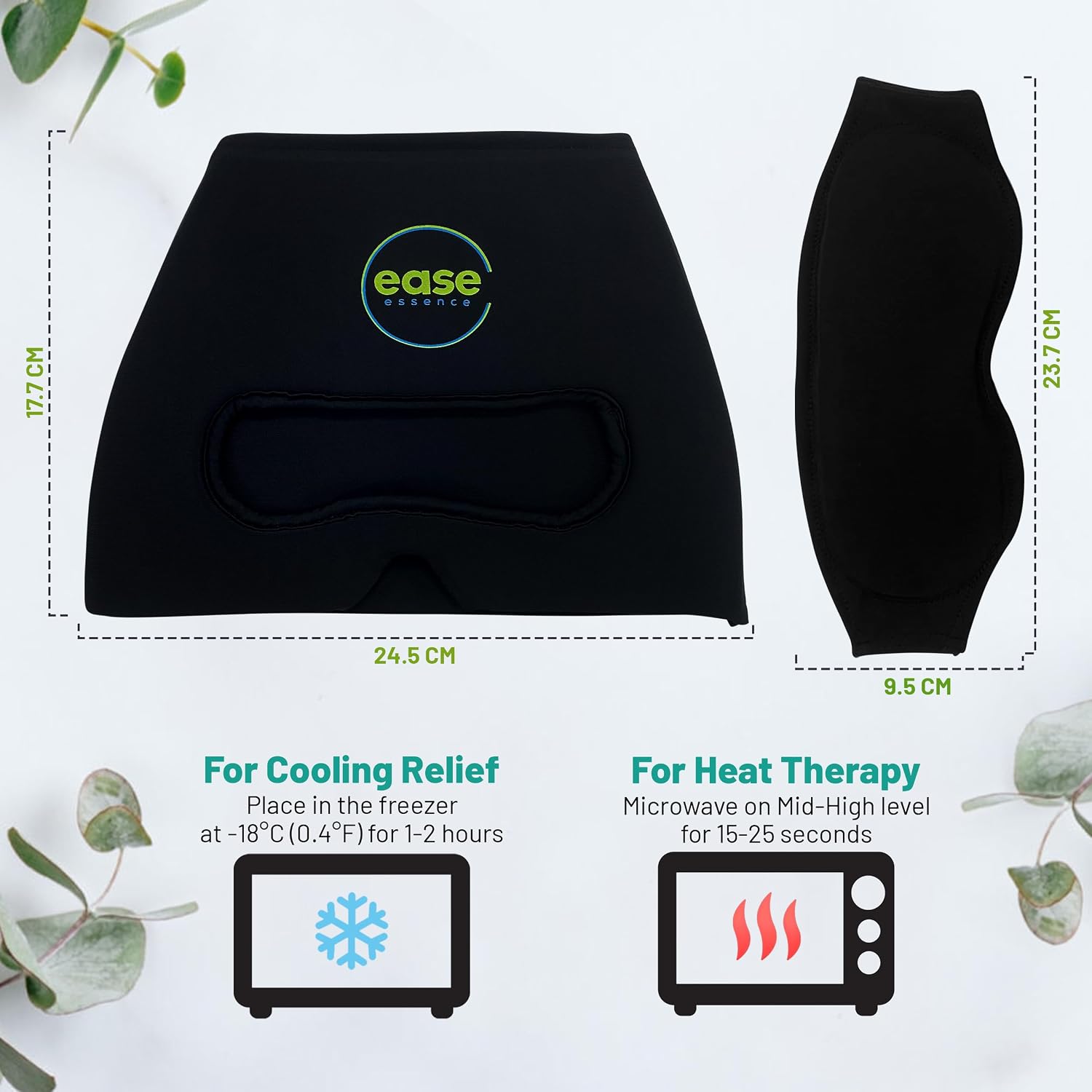
Heat has a different role. Tension-type headaches, which often coexist with migraine or follow one, involve muscle tightness in the neck and upper back. Gentle warmth applied to the neck and shoulders can ease that muscular component. A 2-in-1 cap that can be used with either cold gel packs or warm ones gives you both options without buying two separate tools.
Light and photophobia — blocking light to calm the nervous system
Photophobia (sensitivity to light) is one of the most common and debilitating migraine symptoms, present in the majority of attacks. But light sensitivity is not just a symptom — it also actively worsens the pain. Even moderate ambient light during an attack can increase the intensity of perceived pain, because visual cortex activity during migraine is already amplified.
Blocking light is one of the fastest ways to reduce one of those amplifying inputs. In biohacker terms, you are reducing the load on an already overloaded sensory system. Combined with cold, darkness can help nudge the nervous system toward a quieter parasympathetic state — the opposite of the fight-or-flight heightening that makes migraine pain feel so overwhelming.
Sleep and circadian rhythm — consistency reduces attack frequency
Disrupted sleep is one of the most commonly reported migraine triggers. Both too little sleep and too much sleep are associated with increased attack frequency in many sufferers. The circadian angle is important: it is not just the quantity of sleep but the consistency of the schedule that appears to matter. The body's biological clock governs inflammation cycles, cortisol rhythms, and the regulation of neurotransmitters linked to migraine — including serotonin.
The practical implication: keeping a consistent sleep and wake time (even on weekends) is one of the highest-leverage habits for reducing attack frequency over time. It is slow, unsexy, and free.
Breath and vagal tone — slowing the nervous system down
Slow, diaphragmatic breathing — particularly breathing patterns that extend the exhale relative to the inhale — is known to increase vagal tone, meaning activity in the vagus nerve, which runs the body's parasympathetic (rest-and-digest) system. Migraine attacks are associated with an autonomic nervous system that is tilted toward sympathetic arousal. Breathing can provide a gentle counter-signal.
A simple and commonly used pattern: inhale slowly through the nose for 4 counts, exhale through the nose for 6–8 counts. Repeat for 5–10 minutes. There is no prescription involved, no tolerance effect, and it can be done lying down with a cold cap on your head. Many people find that slow nasal breathing during a migraine does not eliminate the pain but makes it easier to stay still and rest — which accelerates recovery.
Hydration and electrolytes
Dehydration is commonly discussed as a migraine trigger, and maintaining good baseline hydration is generally cited by patient organizations including the American Migraine Foundation as a sensible preventive measure. Magnesium in particular is frequently discussed in the migraine literature — several studies have explored its relationship to attack frequency, and it is mentioned in some clinical guidelines. The evidence is mixed and the optimal approach varies by individual, so if you are considering supplementation, discuss it with a healthcare provider rather than self-prescribing.
At minimum: staying well hydrated day-to-day and drinking water with electrolytes early in an attack costs nothing and carries no downsides.
Trigger logging and the quantified self
The most powerful long-term tool in any migraine protocol is data. Triggers are highly individual — what reliably precedes an attack in one person does nothing of note in another. Without tracking, patterns are invisible. With 8–12 weeks of consistent logging, most people can identify two or three strong personal triggers they did not know they had.
What to log: sleep time and quality, screen time (especially before bed), alcohol, caffeine timing, meals and skipped meals, weather changes (barometric pressure drops are a frequently reported trigger), stress level, and for those who experience hormonal migraines, cycle phase. A simple notes app works. A dedicated migraine diary app (several are available free) gives you visualization over time.
The onset protocol: your first 20 minutes
When the first warning signal arrives — an aura, a warming temple, a sudden light sensitivity, a neck tension that feels different — time matters. Here is a step-by-step onset protocol to run through immediately:
- Recognize the signal. Acknowledge that an attack may be starting. Do not wait to be sure — act on suspicion.
- Get your cold cap on. Place it in the freezer if it is not already cold (or use the pre-frozen pack). Put it on with 360° coverage — forehead, temples, back of the head. Drop the eye mask if light sensitivity is present.
- Find a dark, quiet space. Dim or eliminate all lighting. Reduce noise. Silence your phone. The goal is to minimize sensory input across every channel.
- Begin slow breathing. 4 counts in through the nose, 6–8 counts out through the nose. Stay focused on this for at least 5 minutes. Let your body downshift.
- Hydrate. Drink a glass of water, ideally with electrolytes. Sip steadily rather than all at once.
- Rest horizontally. Lying down keeps blood pressure to the head more stable and removes the postural load from your neck. Minimize movement.
- Log it. As soon as you are able — even a few words in a notes app — record the time, what you were doing before onset, sleep last night, what you ate, and stress level. This data compounds over time.

Two protocol tools in one cap
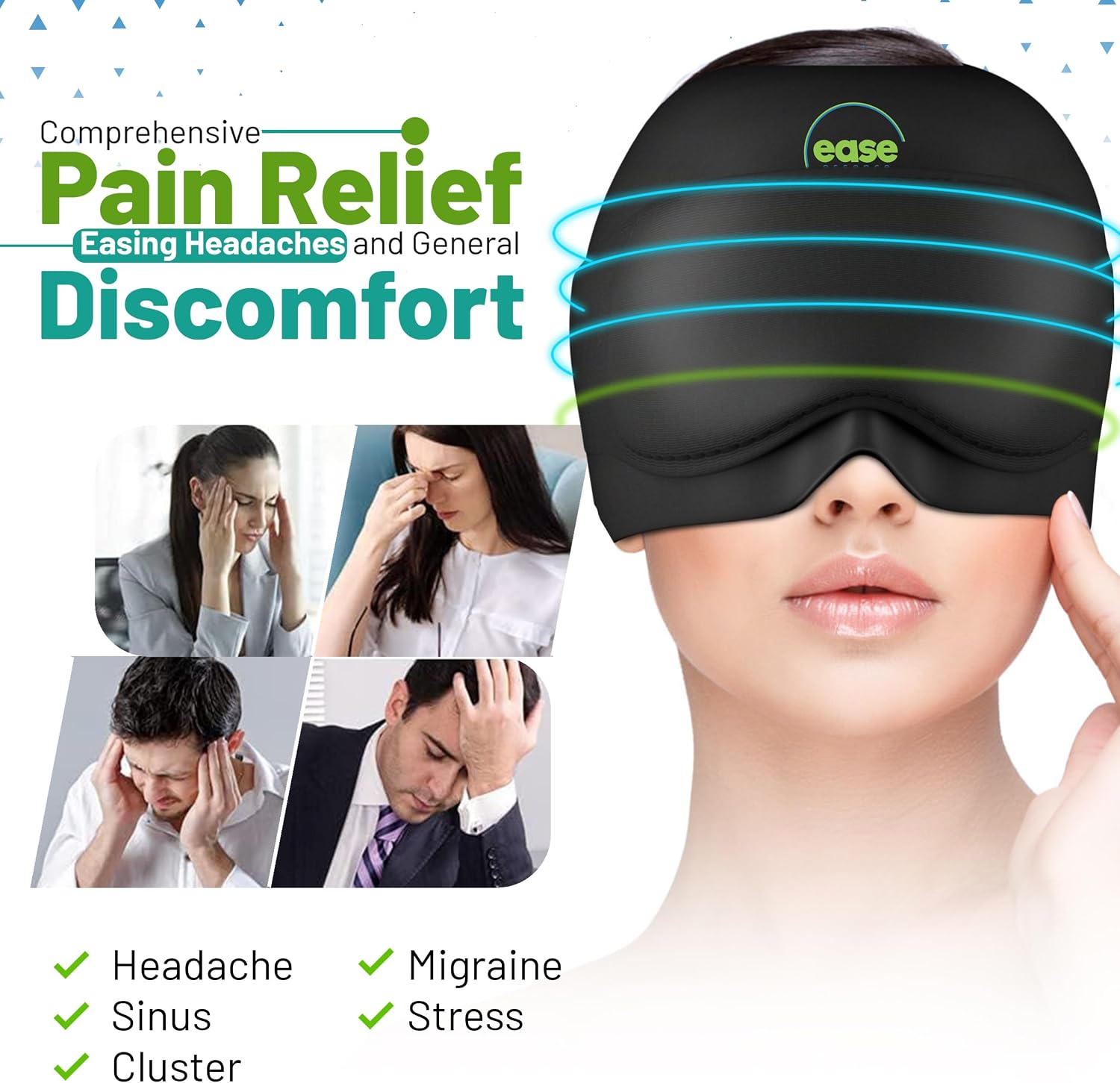
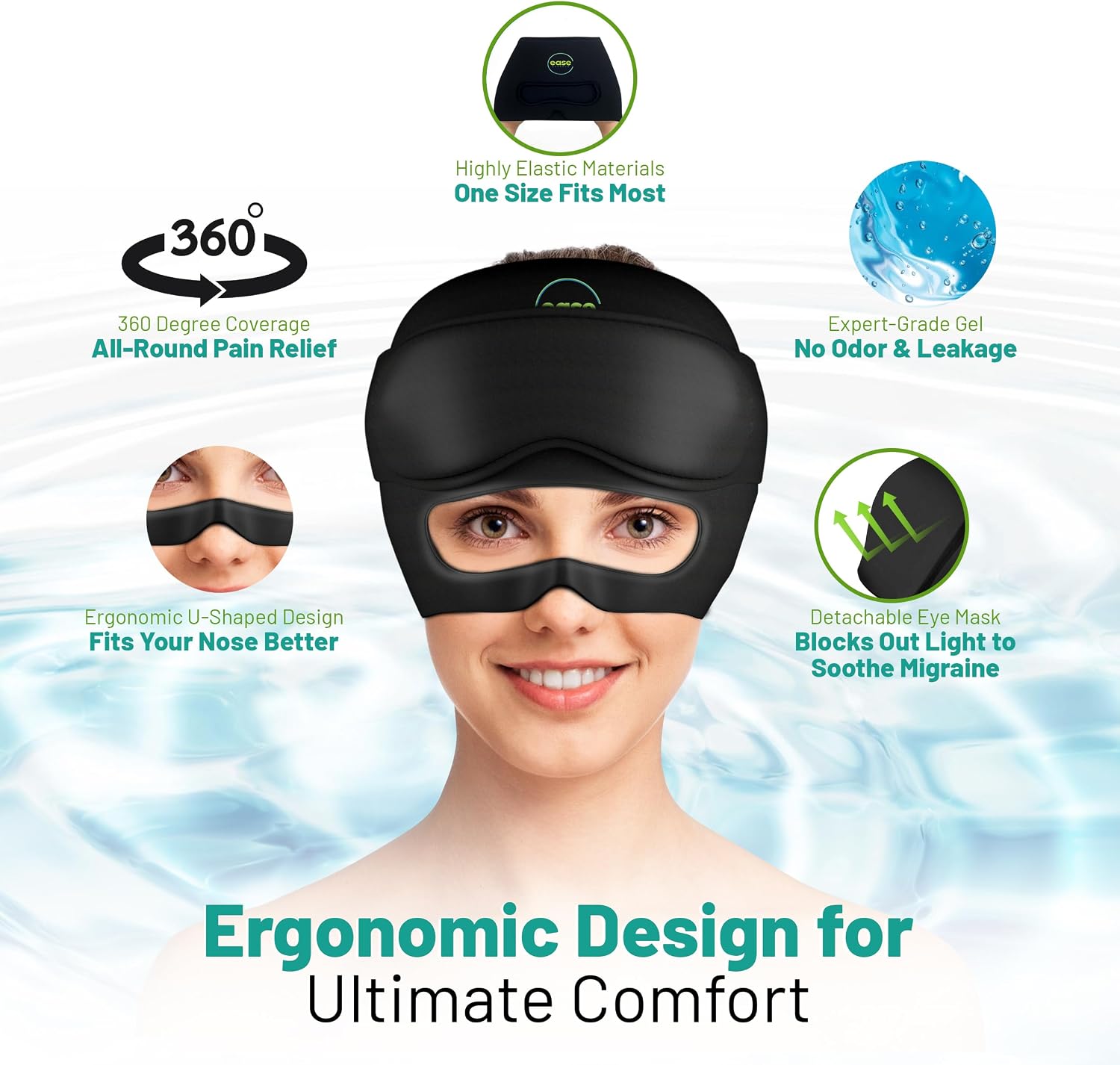
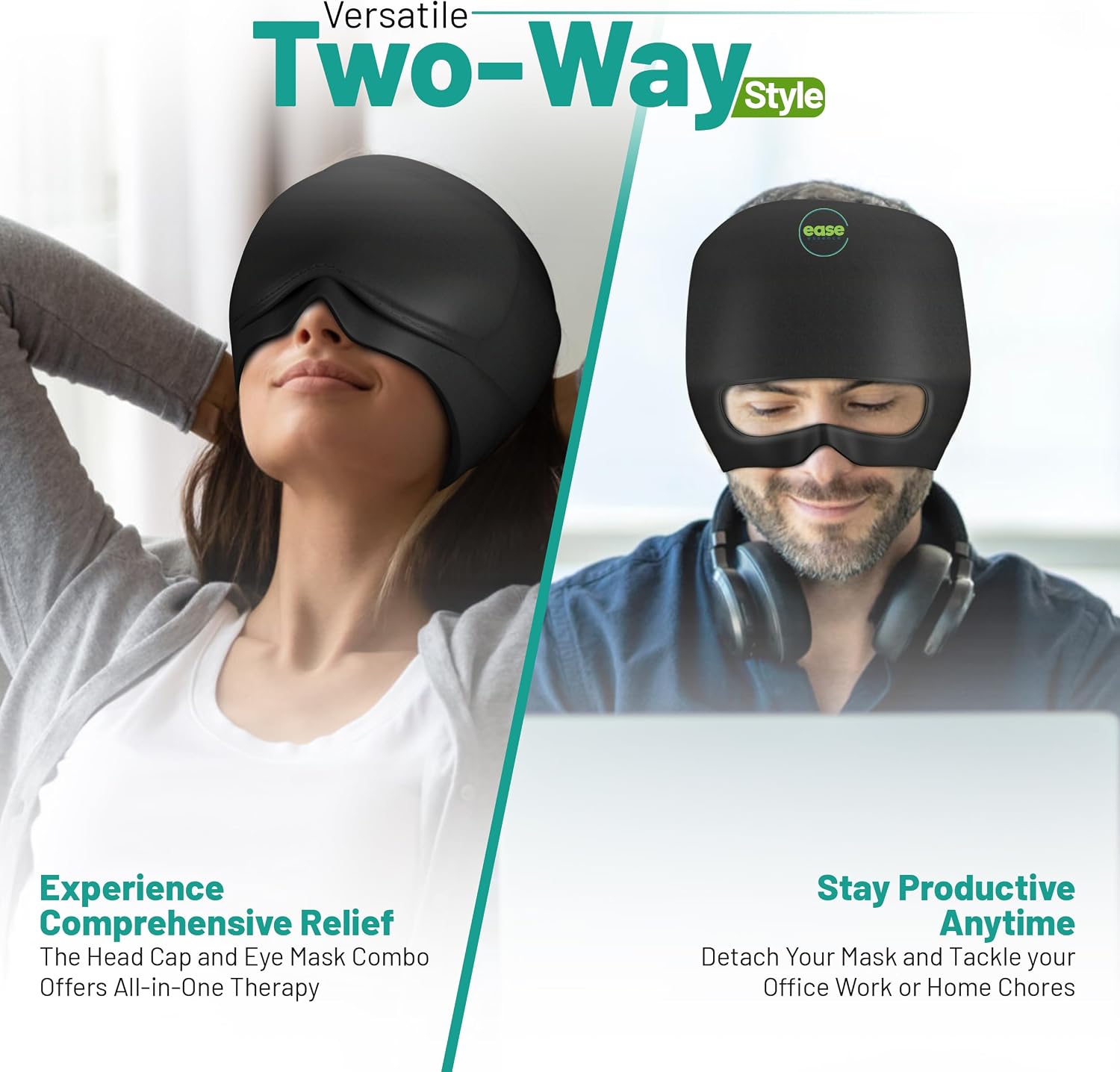
The Ease Essence cap delivers 360° cold or heat plus a detachable light-blocking eye mask — hands-free, so you can stay still and breathe while it works.
Where the Ease Essence cap fits the stack
A physical migraine protocol has a lot of moving parts. The Ease Essence Migraine Relief Cap consolidates two of the most important ones into a single hands-free tool.
The 360° stretch-to-fit design means the cold gel contacts the forehead, temples, and back of the head simultaneously — not just a flat patch over one spot. The detachable gel eye mask adds light-blocking, turning two separate interventions (cold therapy and darkness) into one action. Because it is entirely physical — no chemistry, no metabolism, no tolerance — you can use it every attack, at any frequency, with exactly the same effect each time.
The cap works with both cold and heat. Cold is typically more effective at migraine onset for the vasoconstriction effect; heat at the neck and shoulders can ease the tension-type component that often follows. Having both options available means you can match the tool to the phase of the attack.
| Protocol tool | What it does | When to use it | Ease Essence covers it? |
|---|---|---|---|
| Cold therapy (360°) | Vasoconstriction, nerve cooling | Earliest sign of onset | Yes — cold gel packs |
| Light blocking | Reduces sensory amplification | Any time photophobia is present | Yes — detachable eye mask |
| Heat therapy | Eases neck/shoulder tension | Tension component, postdrome | Yes — warm gel option |
| Slow breathing | Increases vagal tone | Immediately at onset, sustained | Pair alongside the cap |
| Hydration | Addresses a common trigger | At onset and preventively | Separate — drink water |
| Trigger logging | Reduces long-term frequency | After every attack | Separate — notes/app |
No single tool solves migraine. But a stacked, consistent protocol — applied the same way every time — gives your nervous system the best possible signal to wind down. The biohacker insight is that repeatability and speed matter more than complexity. A simple routine you actually run in the first five minutes beats an elaborate one you start an hour later.
If you want to go deeper on the cold therapy side of this protocol, our guide on why cold therapy stops a migraine in its tracks covers the physiology and the 2013 clinical evidence in more detail.
Frequently asked questions
Can you really shorten a migraine without medication?
Many people find that intervening early with a combination of cold therapy, light blocking, slow breathing, and rest meaningfully reduces how long and intense an attack feels. These methods do not work the same way for everyone and they are not a substitute for medical care — but for many sufferers they can take the edge off, particularly when applied at the very first sign of an attack.
What is the most important step in a biohacker migraine protocol?
Speed is the most commonly cited factor. Acting at the earliest warning sign — an aura, a warm temple, a shift in light sensitivity — gives every tool in the stack its best chance. Waiting until the migraine is fully established makes it much harder to influence the attack's course.
Where does the Ease Essence cap fit into a drug-free migraine protocol?
The Ease Essence Migraine Relief Cap covers two of the most-used biohacker migraine tools at once: 360-degree cold (or heat) therapy and light blocking via the detachable eye mask. It is hands-free so you can stay still and focus on breathing, and there is no tolerance build-up because it is a physical tool rather than a medication.
Medical disclaimer: This article is for general education only and is not medical advice. Ease Essence is a drug-free wellness product, not a medical device, and is not intended to diagnose, treat, cure or prevent any disease. If your headaches are frequent, severe, sudden or unusual, please consult a qualified healthcare professional.